Global E-Invoicing Guide: Requirements by Country in 2027
A selected-country guide to rollout dates, established systems and practical invoice-data preparation for 2027.

E-invoicing requirements in 2027 differ by country, transaction and business size. Some markets are introducing new phases; others already operate established systems. A PDF or an Excel export does not automatically meet a structured invoicing obligation.
This guide covers nine selected markets across Europe, the Middle East, Asia and the Americas. It is a planning overview based on official information checked on November 27, 2026, rather than an exhaustive list of every country's rules.
IntoExcel.com helps organize invoice data from PDFs and images into Excel. It does not issue compliant e-invoices, connect to national submission systems or import standalone XML.
Country comparison for 2027
France
Covered SMEs and microbusinesses join issuance and e-reporting from September 1, 2027. Receipt obligations began in September 2026. Confirm transaction scope and your approved-platform arrangements. Official guidance.
Germany
For domestic B2B issuance, the general transition ends in 2026; issuers with prior-year turnover up to €800,000 retain a 2027 transition. EDI transitions and exemptions also matter. Official guidance.
Belgium
Structured invoicing already applies to nearly all domestic transactions between Belgian VAT-liable businesses from January 2026. In 2027, focus on operating that process; private-consumer supplies are outside this issuance obligation. Official guidance.
Italy
SdI and XML invoicing are established. FatturaPA is an Italian format, not a new 2027 launch. Check the applicable transaction rules and preserve the structured source. Official guidance.
Poland
From January 1, 2027, KSeF reaches the smallest businesses previously using the monthly PLN 10,000 gross-sales transition. Check statutory exceptions and your issuance workflow. Official guidance.
United Arab Emirates
Covered persons: implementation by January 1, 2027 at revenue ≥ AED 50 million; July 1 below that level. Government entities: October 1. Provider appointment is a separate earlier obligation. Official guidance.
Saudi Arabia
Integration is phased. ZATCA wave 25 targets VAT-subject revenue above SAR 187,500 in any of 2022–2025, with integration by February 1, 2027. Check your notification. Official guidance.
Singapore
InvoiceNow applies to new voluntary GST registration applications from April 2026. Wider existing-business phases begin in 2028, not universally in 2027. Follow your assigned date and exclusions. Official guidance.
Mexico
CFDI 4.0 is the current established invoice version, mandatory since April 2023. For 2027 planning, review your existing issuance process rather than assume a new nationwide launch. Official guidance.
Turn country rules into an implementation plan
Create a separate record for each legal entity and transaction type. A domestic B2B sale, a consumer sale and a cross-border service may follow different rules even within the same country.
Record the applicable scope, issuance and receipt dates, data format, transmission channel, correction process and retention arrangements. Assign a responsible person and retain the official source link. Check these records again before implementation because amendments can change the plan.
When selecting software or a provider, ask about integration, mandatory fields, rejection handling, access to originals and exports. Request setup fees, recurring charges, transaction limits and support terms in writing. There is no single worldwide price or universal compliance package.
Keep structured processing and review tables connected
Use reliable XML or accounting exports directly where available. Re-reading structured data with AI can introduce errors. A readable PDF is useful for a separate review, but may omit fields present in the structured original.
A common internal register can help teams compare invoices across countries:
| Column | Suggested kind | Purpose |
|---|---|---|
| Supplier and tax identifier | Text | Preserve identifiers and leading zeros |
| Invoice number and system reference | Text | Keep distinct references in separate columns |
| Invoice date and due date | Text | Check date conventions |
| Net, tax and total | Number | Review amounts against the source |
| Currency | Currency | Separate currencies before calculating totals |
| Item description and quantity | Text / Number | Analyze repeated entries |
This is a management template, not a legal invoice schema. Add entity, country, payment status and review status from reliable business records when they are absent from the invoice.
Use IntoExcel for readable invoices
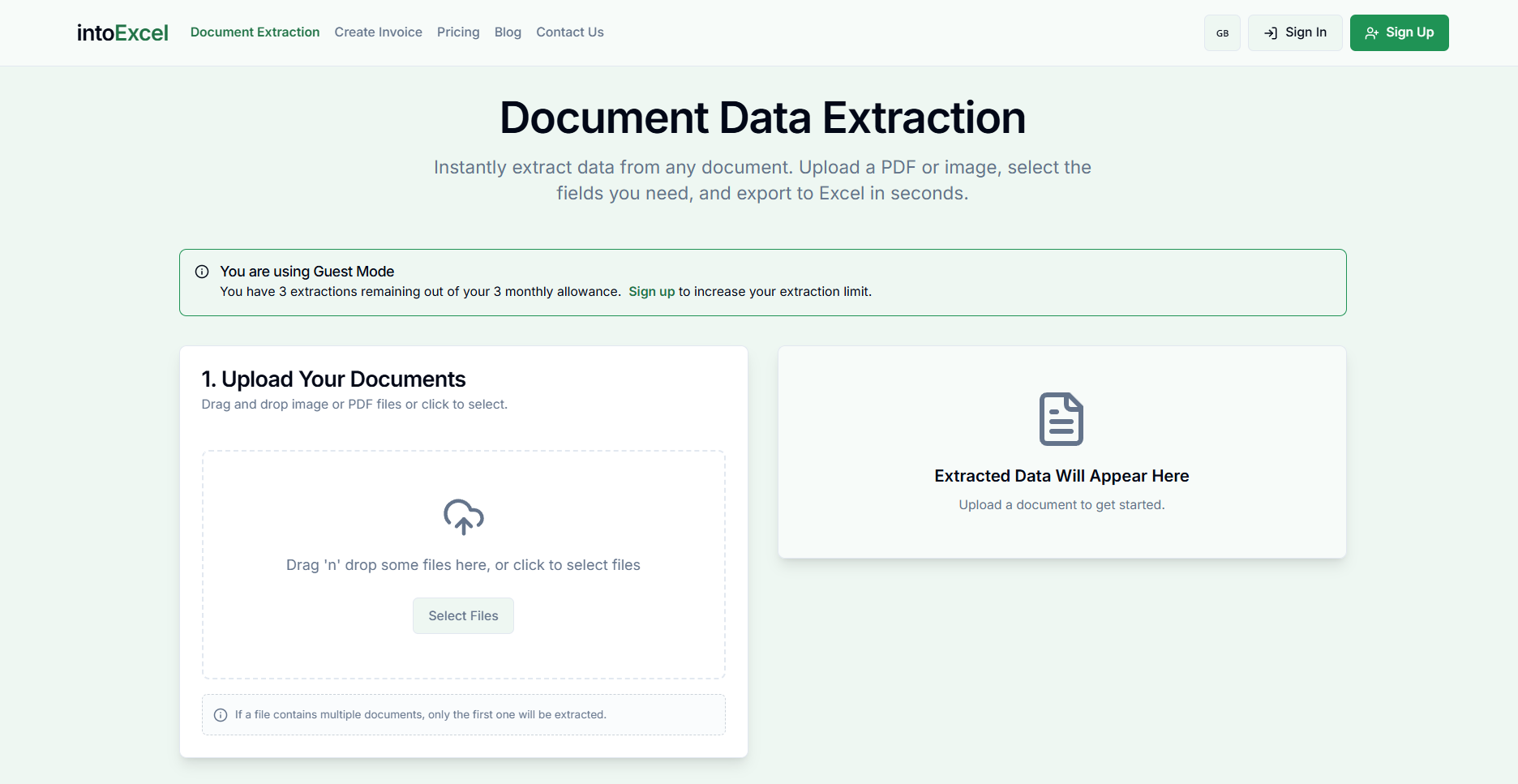
- Open the IntoExcel extraction page.
- Upload a readable PDF or image, keeping one distinct invoice per file.
- Select fields or create custom ones with a name and kind: Auto, Text, Number, Percentage or Currency.
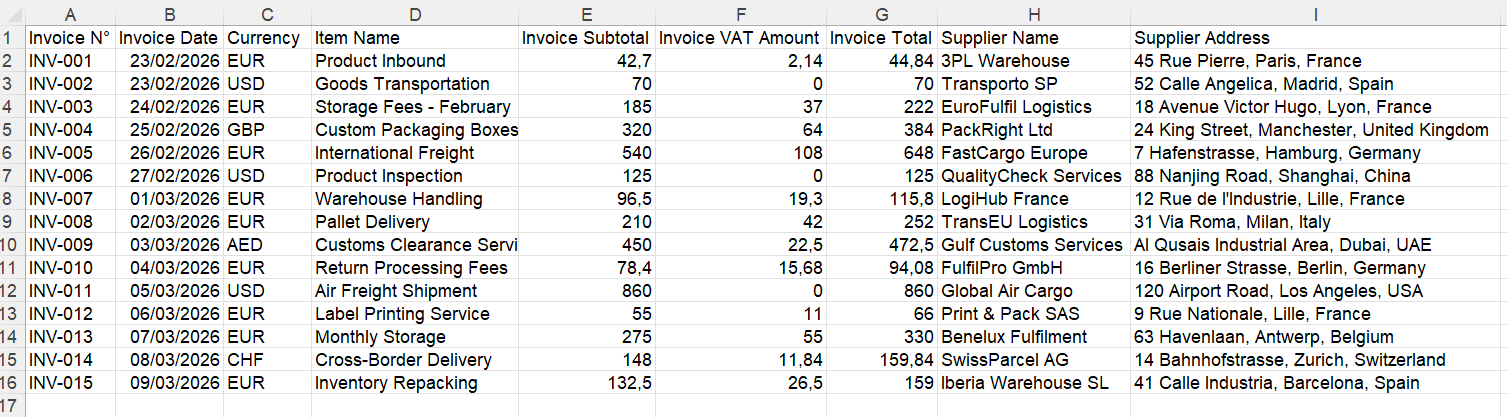
- Choose one row per document for a register or one row per item for product and service analysis.
- Extract, inspect the editable table, correct errors and download Excel.
Only information present in the supplied copy can be extracted. If you have only XML, use a suitable structured export or obtain a readable rendering in compatible software first.
Review before combining countries
Keep currencies separate unless you apply an explicit conversion method. In item mode, shared invoice totals may repeat: do not sum them as separate invoices. Compare correction documents, signs, tax amounts and references with their sources.
Missing values remain blank, not zero. The current flow processes the first distinct document and returns up to 500 rows per file. Read notices and verify completeness. Preserve original invoices and official records in your existing process.
A hypothetical purchasing team could combine reviewed PDF extractions with structured exports for an internal supplier comparison. That spreadsheet would support analysis without replacing country-specific invoicing systems. This is an illustration, not a customer story or measured savings claim.
Try a readable invoice on IntoExcel.com, or follow our structured invoice-to-Excel guide.
Ready to try it yourself?
Stop wasting hours on manual data entry. Extract your PDF data to Excel instantly with our AI-powered tool.
Extraction